
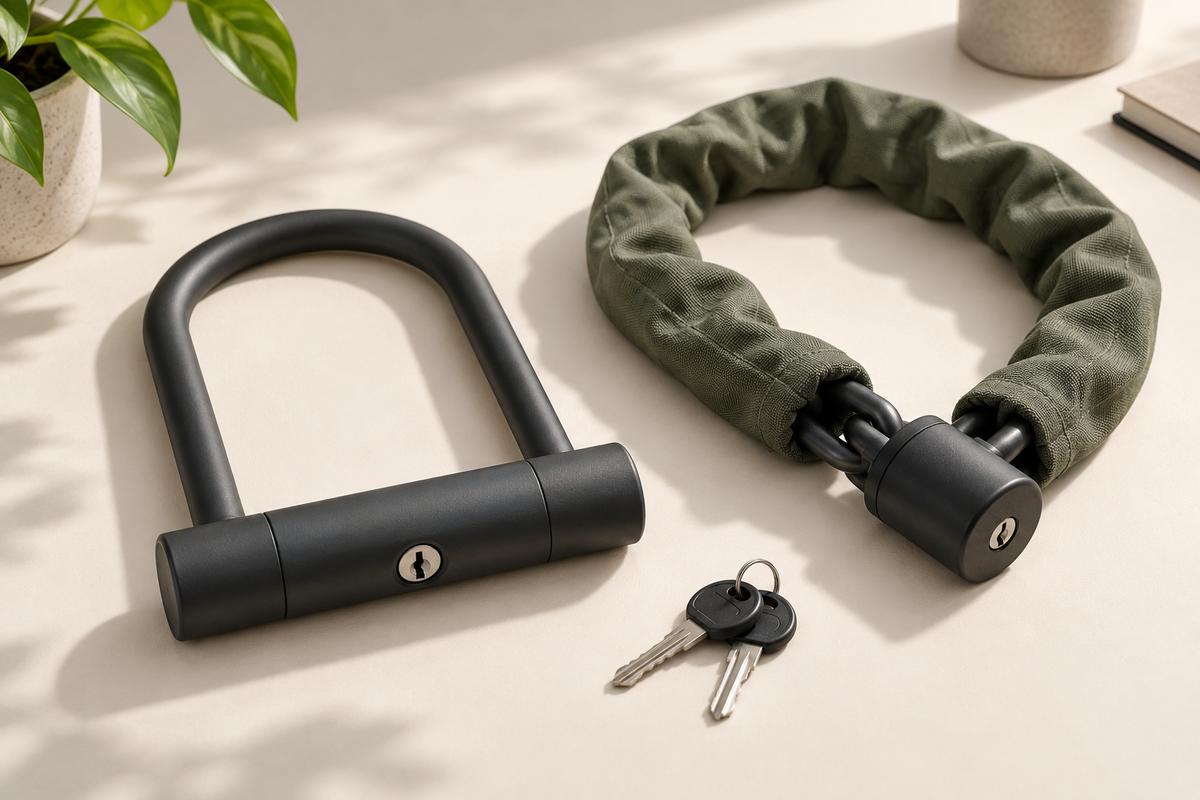
Quick answer: Connect your e-bike's main frame to a solid fixed anchor, give both wheels protection, and decide which removable belongings to take inside. Use suitable, good-quality locks and check that they are actually closed before you walk away. No parking arrangement makes a bicycle theft-proof.
A work commute ends with a parking decision that may last several hours. The useful question is not just which lock to buy: it is whether your bicycle, locks and workplace parking fit together into a routine you can repeat every morning.
Start with the parking space you will actually use
Before the first commute, ask your employer where bicycles may be left and whether there is an approved indoor or access-controlled area. Visit the parking space with your bike if possible. Check that you can reach a substantial part of the frame with your lock and that the stand itself is firmly fixed.
For outdoor parking, favour recognised cycle facilities with good visibility and lighting. The Police Service of Northern Ireland's e-bike guidance recommends overlooked parking and cautions against isolated locations and open-ended structures. Lighting, cameras or passing people are additional considerations, not substitutes for a physical lock.

Think about the journey home as well as arrival. A location that is easy to reach in daylight may feel different after a late shift. If the available stand does not let you secure the frame properly, find another permitted parking option rather than improvising around a weak attachment point.
Make the frame-to-anchor connection first
Trace what your main lock connects. It should secure the bicycle's frame to the fixed object, not simply stop a wheel from turning. German police emphasise both the frame connection and choosing a lock large enough to reach a securely anchored object. Their lock-selection guidance also recommends additional protection for the wheels and positioning the lock away from the ground.
Try your intended arrangement at the real stand. The lock's internal opening or usable chain length must accommodate the frame and anchor without forcing the lock against cables, brake hoses or other components. Close and reopen it once before relying on the setup for a whole working day. If the fit is awkward, change the lock or parking arrangement.

Frame shapes vary, so a photograph of another rider's arrangement is not proof of compatibility. Follow the lock manufacturer's instructions, and ask the bicycle retailer to help you find an appropriate contact point if the route around your frame is unclear.
Give each wheel a deliberate plan
The Metropolitan Police recommend two quality locks, with at least one D-lock, and different lock types where possible. Their advice is to protect the frame and both wheels at a secure stand. The key is coverage: look at what each lock actually protects, rather than merely counting the locks you have brought.
For your own setup, identify how the front wheel is protected, how the rear wheel is protected and where the frame is attached to the anchor. If you cannot explain those three connections clearly, review the arrangement before leaving. Choose the actual lock models and sizes for your bicycle and parking environment; the equipment pictured here is illustrative, not a tested lock recommendation.
Plan what comes indoors with you
Empty open baskets and take your bag, phone and other valuables with you. Decide in advance what to do with accessories designed for easy removal, such as clip-on lights or a detachable display. Equipment differs between models: an item shown in an illustration is not necessarily removable from your bike.
PSNI's e-bike-specific advice includes considering battery security. If your battery is designed to be removed by the rider, follow the bicycle's instructions and decide where you will carry and store it safely at work. Do not dismantle an integrated battery or improvise an electrical modification as part of a parking routine. Where removal is not intended, ask the manufacturer about the appropriate security arrangements.

Put everything you intend to carry on one table before your first trip. This small rehearsal tells you whether you need a different bag, whether there is permitted storage at work and whether an accessory will become an inconvenience every morning.
Check lock requirements without assuming one European standard
Match any required lock approval to the exact model, and read your own insurance policy's parking and locking conditions if you rely on insurance. Do not assume that a lock's marketing name, price or colour is an approval, or that one country's rating automatically satisfies every insurer.
For example, France's cycling federation FUB publishes lock guidance and references its testing system. German police point readers to tested products and explain that manufacturers' own security scales are not uniform. These are starting points for checking the product you are considering, not a promise of insurance cover.
Keep a private ownership record with the bicycle's identifying details, a clear photograph and purchase evidence. PSNI recommends noting the frame number and, where present, the battery serial number. Check the recognised registration options where you live. Keep keys and sensitive ownership details out of public photographs.
Try the routine with your commuter bike before buying accessories

If you are considering the TTGO C3 SE in White, include workplace parking in your decision alongside riding fit and storage at home. Use the actual frame and stand measurements when choosing locks. This article does not claim that the C3 SE includes the locks or accessories shown, or that a particular lock or tracker has been tested with it.
Check the current product page for the available configuration. Our step-through commuting guide covers mounting, fit and moving the bicycle between the street and storage. If your work journey also includes a train, the German regional-train guide addresses that separate part of the trip.
Your final check before walking away
| Check | What to confirm |
|---|---|
| Fixed point | The anchor is solid, securely fixed and permitted for bicycle parking. |
| Frame and wheels | You can identify how the main frame and each wheel are protected. |
| Closed locks | The locks are fully closed according to their instructions; the keys are with you. |
| Removable belongings | Your valuables are taken inside and any rider-removable components have a security plan. |
| Return journey | You can access the parking area and retrieve your belongings when your shift ends. |
Frequently asked questions
Is a battery key or GPS tracker enough on its own?
Neither connects the bicycle's frame to a fixed anchor. Plan the physical locking arrangement separately, and check the specific functions of any security feature rather than assuming it prevents the whole bike being taken.
Do I still need to lock the bike inside a workplace bike room?
Keep an appropriate locking routine and follow the facility's rules. FUB's guidance recommends locking even indoors; access control alone does not replace securing the bicycle.
What if my current D-lock cannot reach the frame and stand?
Choose a compatible lock or another suitable parking position. Do not settle for an arrangement that leaves the frame unattached just because the lock fits around a wheel.
A good daily routine is one you can check: the permitted parking place, the fixed anchor, the frame, both wheels and your removable belongings. Practise it once when you are not rushing to start work.
Sources and product availability checked on 27 September 2026. This is practical theft-prevention guidance, not a guarantee against theft or a statement of insurance cover. Images include TTGO product photography and illustrative equipment and scenes.
Share:
Can You Take an E-Bike on Regional Trains in Germany?