
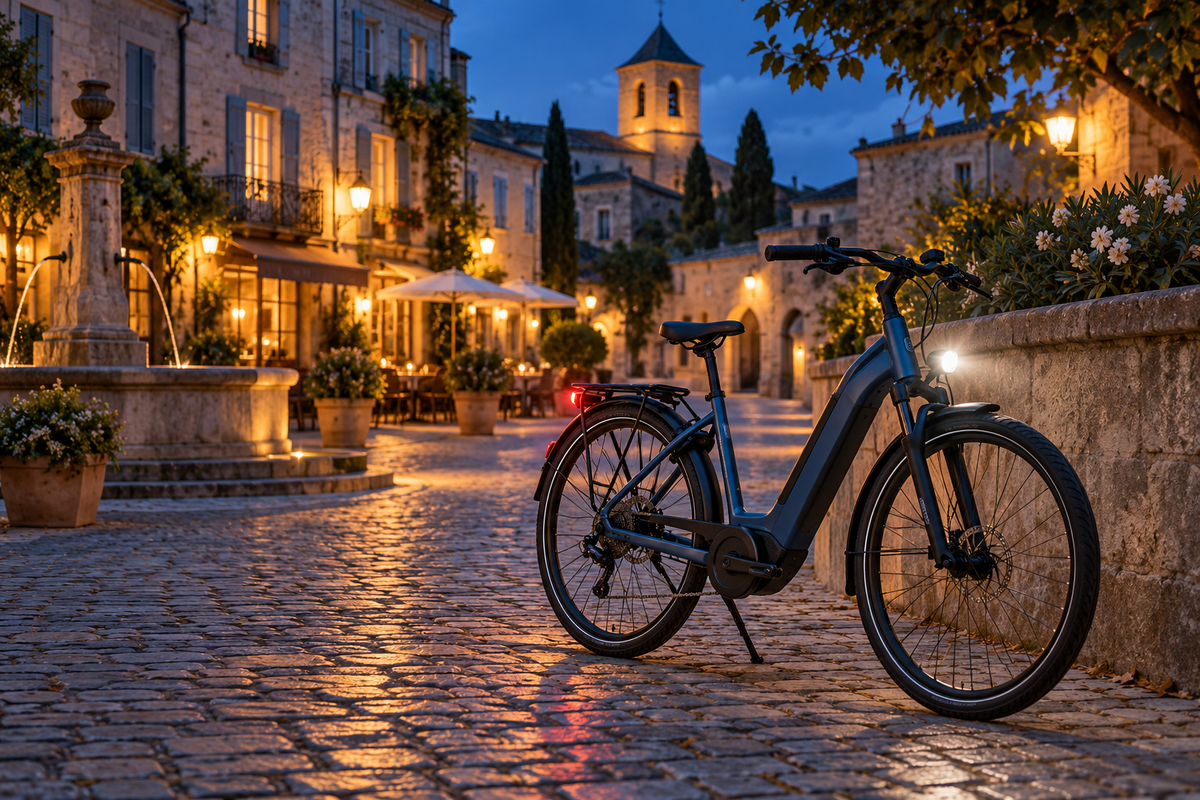
Your morning ride starts in daylight, but the journey home may not. Before buying another lamp, check what is already fitted to your e-bike, which mode it uses and whether your bag hides any of it.
For an e-bike that belongs to the ordinary bicycle category in France, plan for a non-dazzling white or yellow front light and a clearly visible, steady red rear light when riding at night or in poor daytime visibility. Reflectors are a separate requirement. Extra lights can supplement this equipment; they do not make the basic checks unnecessary.
This guide focuses on lighting for bicycle-class pedelecs in France. It does not establish a particular model’s legal category or cover speed-pedelecs and other motor-vehicle categories.
Start with the lights that must be on the bicycle
Paris’s official cycling guidance describes the front and rear position lights required at night or in poor daytime visibility. Check the colour and direction as well as whether each lamp switches on. The current non-flashing rule is explained in the next section.
| Position | What to check |
|---|---|
| Front | A white or yellow light directed forward without dazzling other road users. |
| Rear | A red light that does not flash and remains clearly visible from behind when the bicycle is used. |
The requirement applies at night and when daytime visibility is insufficient. It is not limited to unlit country roads. Treat a dim, foggy or otherwise low-visibility journey as a reason to check the actual conditions, rather than relying only on the time of sunset.

Why a flashing tail light is not the same as a turn indicator
France’s rules distinguish the job a lamp performs. In its May 2025 parliamentary answer, the government explained that the 2024 decree restored the non-flashing requirement for bicycle rear position lights. Permission for additional equipment did not create a general permission to use a flashing red tail light.
Use a stable mode for the front and rear position lights. Optional direction indicators are a different category: these signal a turn using orange flashing light. Do not read an abbreviated reference to permitted “flashing lights” as applying to every lamp on your bike.

Check the controls before leaving. A lamp with several settings may offer steady, pulse and flash options, while an automatic setting may behave differently from the mode you selected manually. Use the manufacturer’s instructions to identify the appropriate setting. If you cannot establish what a mode does or whether it is suitable, ask before relying on it for the ride.
This is a check of the operating mode, not a recommendation to modify a lamp’s electronics or software. A mode’s marketing name is not proof that it satisfies the rule.
Check reflectors even when the lights work
France’s official bicycle-equipment guide, verified in June 2026, lists a white front reflector, one or more red rear reflectors, orange side-visible wheel reflectors and orange pedal reflectors. These requirements are not presented as night-only equipment.
There is a specific wheel-reflector exception for tyres fitted with approved retroreflective devices. A shiny tyre sidewall or an arbitrary reflective sticker is not enough to establish that exception. It does not remove the pedal-reflector requirement.

Make this a separate inspection: identify each reflector, look for damage or obstruction, and check any claimed tyre alternative against its documentation. A working lamp tells you nothing about a missing pedal reflector. Equally, a reflective patch is not a powered lamp.
What can you add?
The French Interior Ministry’s explanation of supplementary lighting separates optional equipment from what is already compulsory. Permitted additions include a second compliant front or rear position light, a red non-flashing brake light, orange flashing direction indicators and additional passive side-reflective or fluorescent material.
Authorised supplementary lights can also be worn by the rider, for example on a helmet. They complement the bicycle’s required lighting. A helmet light alone should not become your substitute for the front or rear lamp that the bicycle must have.
Start by finding a specific gap in your setup. Is your existing light obscured by luggage? Is it damaged? Are you uncertain about its mounting or mode? Resolve that problem before treating extra gadgets as the answer. More equipment also means more controls, mounts and power arrangements to understand.
Check the setup you will actually ride with
Inspect the bike with the bag, rack load and clothing you intend to use. A rear lamp that looks unobstructed on an empty bike may sit behind a hanging coat or an overfilled bag once you are ready to leave.
While stationary in a safe place, check the front and rear views and ask someone to help you inspect visibility if needed. Follow the light manufacturer’s mounting and aiming instructions; avoid choosing a beam angle solely because it looks bright from the saddle. If the mounting position or adjustment is unclear, get help from the seller or a competent bicycle workshop.
For luggage placement, our pannier-fit guide covers the separate issue of clearance around the rack, wheel and rear light. Repeat your light check after changing the load or moving a lamp.
Also establish how each light is powered and controlled. Use the bicycle or lamp manual to find the correct switch, mode and charging procedure. Do not assume that a lit display means both external lamps are on, or that every integrated light behaves the same way when the main battery is low.
Checking a TTGO e-bike before a French commute
If you are considering the TTGO C3 SE in White, use the exact model and version when asking about its equipment. The White variant was available when this guide was checked; other colours may have different stock status.

Ask TTGO support to confirm the supplied lamps, their controls and modes, the reflector arrangement and the instructions for your version. A product photograph can help you identify components, but cannot prove lighting approval or complete compliance in France. Confirm any missing information before relying on the equipment.
For a useful final check, ask: are the correct lamps operating in the appropriate modes, are they unobstructed with my normal load, and have I checked the reflectors separately? Keep the instructions accessible so a changed setting or replacement part does not turn into guesswork on the way home.
Checked on 24 October 2026. This is a lighting guide, not a complete checklist of French cycling obligations. Official sources are linked beside the relevant rules. Generated diagrams and scenes are illustrative; no product approval or measured lighting performance is implied.
Share:
Do You Need E-Bike Insurance in Germany?