
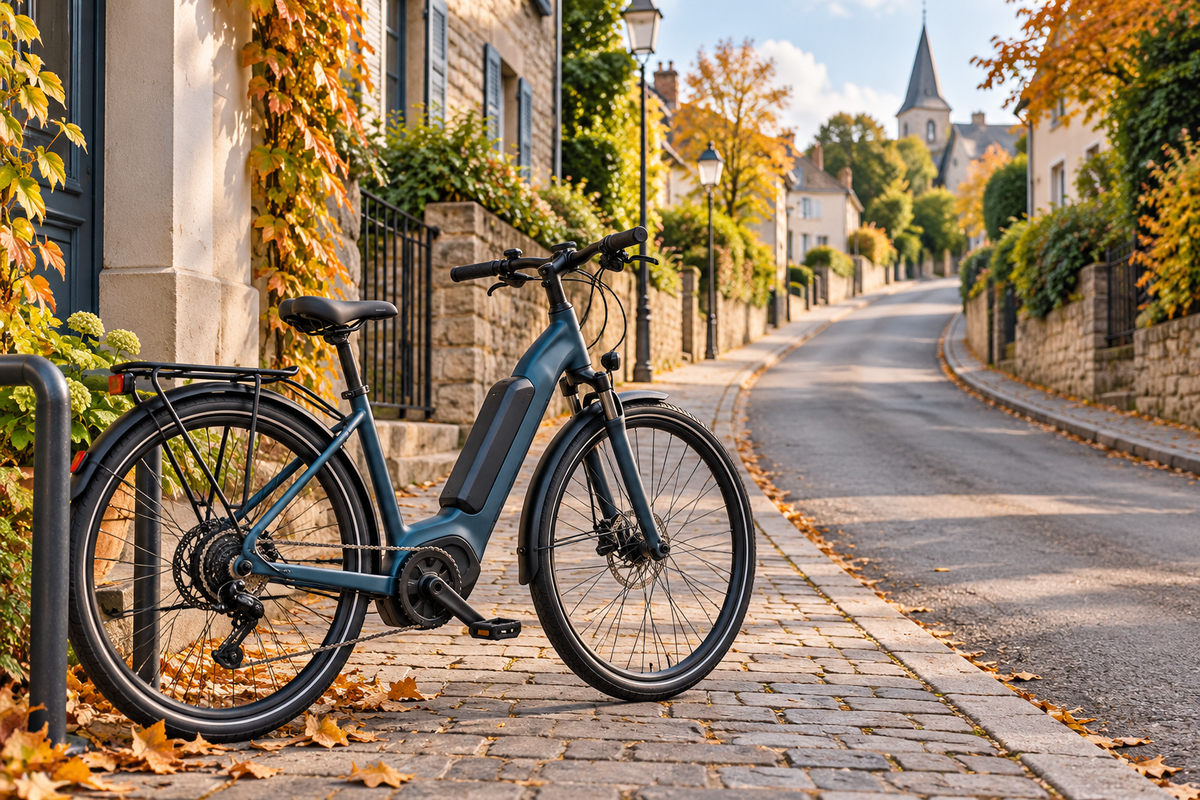
You reach a hill, your pedals feel heavy, and your e-bike has two different controls within reach. Should you change the mechanical gear or turn up the assistance?
Prepare an easier mechanical gear before the climb, then adjust the assistance to the support you need. Gearing changes how you pedal; the assist setting changes the motor’s support. They work together, but increasing assistance does not move the chain to another gear.
The shifting advice here is for conventional, manually operated derailleur systems. Internal-gear hubs, automatic shifting and other arrangements can require different techniques. Follow the instructions for your actual bicycle and components.
Two controls answer two different questions
Start by identifying the gear shifter and the assistance control while the bike is stationary. They may both show numbers, but those numbers describe different things.
| Control | What it changes | The question it helps answer |
|---|---|---|
| Mechanical gear | The relationship between pedalling and driving the wheel through the transmission. | Does this gear let me pedal comfortably at my current speed? |
| Pedal-assist level | The support requested from the electric system. | How much help do I want from the motor? |
Liv’s explanation of pedal assistance describes changing mechanical gears separately from selecting a support mode. Mode names, available levels and response vary by system, so do not assume one brand’s setting has the same effect on another bike.

Think of an “easier” gear as one that requires less force for each pedal stroke in the same riding situation. It does not mean the hill has become shorter or that a particular energy saving is guaranteed. The useful observation is how your pedalling feels, not whether the two displays show matching numbers.
Make the gear choice before the slope forces it
Look ahead for the climb and choose an easier gear while you can still pedal smoothly. Cycling UK’s advice for new riders warns against carrying a hard, flat-road gear into a climb and waiting until progress becomes difficult.
On a familiar commute, notice where the effort begins to rise. That gives you a practical place to prepare next time. Your choice may change when you carry shopping, encounter a headwind or approach more slowly. There is no single gear number that answers all those situations.
If you already have a suitable mechanical gear but want more support, adjust the assist level using the bike’s instructions. You do not need to search for an imaginary perfect pair such as “gear two plus assist four”. Different drivetrains and control systems make that kind of universal pairing unhelpful.

If you need to shift during the climb
For a conventional derailleur, the chain needs to move forward to change sprockets. The shifting section of Trek’s bicycle owner’s manual explains that easing pedal pressure reduces chain tension and helps the shift happen smoothly.
While you can maintain safe control, briefly lighten your pedalling as you operate the appropriate shifter. Keep the pedals moving forward, allow the shift to finish, and then resume normal pressure. This is different from stopping the pedals and forcing the lever while the chain is stationary.
Do not experiment with unfamiliar buttons on a steep section or while negotiating traffic. Learn the controls beforehand in a suitable, quiet practice area. If you cannot continue with stable control, find a safe way to stop and reassess the route; getting off and walking where appropriate is a valid option.
Why the motor’s position matters
The relationship between gears and motor support depends on the drive system. As explained in TENWAYS’ overview of motor layouts, a conventional mid-drive sends motor power through the bicycle’s drivetrain, whereas a wheel-hub motor applies its drive at the wheel rather than through the bicycle’s chain and gears.

That means changing mechanical gear on a hub-driven e-bike does not directly change the motor’s internal gearing. It still changes the rider’s pedalling, so the mechanical gears remain useful. Conversely, advice about keeping a particular mid-drive motor in a preferred operating range should not become a universal instruction for every e-bike.
Motor position alone does not tell you the right assist setting, a maximum climbable gradient or a guaranteed range. Keep the task concrete: choose a usable mechanical gear, select suitable support and remain in control.
Remember the next start as well as the current climb
A hill may end at a junction, or you may need to stop halfway along your route. When it is safe to do so, prepare a suitable starting gear before you finish slowing down, while the drivetrain is still moving. Being stationary in a hard gear can make the next departure awkward.
If you have already stopped, do not try to force a derailleur shift by pressing the shifter repeatedly against a stationary chain. Follow your bicycle’s instructions for setting up a controlled restart. Avoid turning a difficult start into an improvised test of maximum assistance.
Practise the distinction on your own bike
Use an easy, quiet location to learn what one gear change feels like and how an assist adjustment differs. Work on one control at a time, keep your attention on the route, and stop somewhere safe to consult the instructions if you are uncertain. Familiarity should come before the demanding part of the commute.
The TTGO C3 SE in White is listed with a Shimano seven-speed transmission. Use the exact-version instructions to identify its mechanical shifter and electric controls; a “seven-speed” description does not tell you which button increases assistance. The White variant was in stock when this guide was checked.

If the supplied instructions do not answer a control question, ask TTGO support with the model and version. Do not copy lever directions, display shortcuts or automatic-shifting features from a different bicycle’s tutorial.
Know when the problem needs a check
Repeated chain skipping, a gear that will not engage or persistent unusual noise should not be answered by increasing assistance and pushing harder. Have the bicycle checked by the seller or a competent workshop instead of forcing the shift. Our support-request guide explains how to provide useful details without attempting speculative repairs.
For the next hill, make two separate decisions: which mechanical gear suits your pedalling, and how much electric support you need. Preparing early makes those decisions easier to manage.
Checked on 26 October 2026. This guide does not specify a universal gear, assistance level, cadence or climbing limit. Diagrams show general concepts; the product photograph shows the actual TTGO model.
Share:
What Lights Does an E-Bike Need in France?