
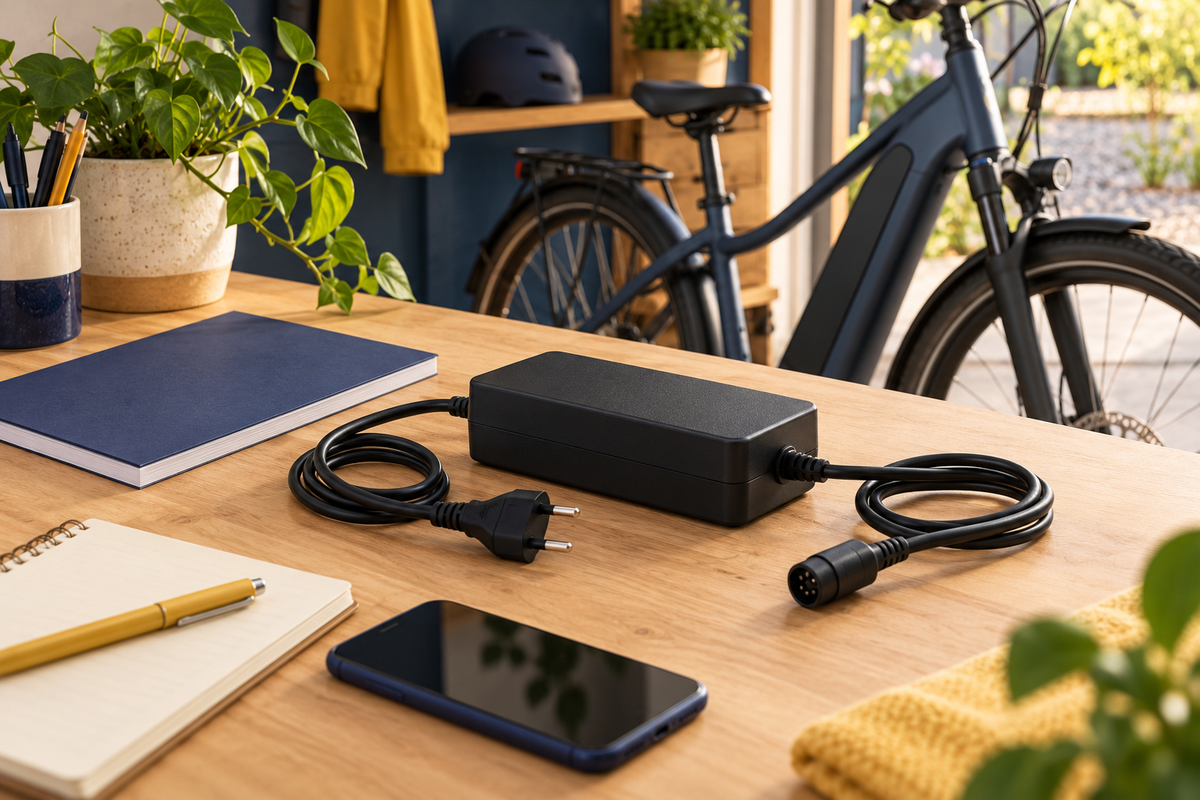
Start with the e-bike or battery-system manufacturer and ask for the exact replacement charger approved for your setup. A connector that fits, a familiar brand name or a matching number in an online listing is not enough to establish compatibility.
Whether the original charger is missing, damaged or no longer available, the useful next step is identification. This guide helps you collect the right details, ask a precise question and check the replacement you receive. It does not provide a formula for matching chargers or instructions for electrical testing.
Separate identification from approval
The UK Department for Transport's battery-safety guidance advises buying genuine replacement chargers authorised by the e-cycle or drive-system manufacturer. That is safety guidance from Great Britain, not a claim about one uniform law across Europe.
The practical implication is straightforward: use labels and photographs to help the manufacturer identify the system, then obtain confirmation of the replacement. Do not treat your notes as a compatibility test you can complete yourself.
For a second-hand bike, say whether the battery or charger has been changed. A charger that came with a used bicycle is not automatically evidence of the original factory pairing. If its history is unknown, include that uncertainty in the enquiry.
Why “the plug fits” is the wrong buying test
Electrical Safety First recommends a manufacturer-supplied or approved replacement and warns against buying equipment without charging instructions.

Appearance and electrical figures are identification clues, not permission to substitute a charger. Ask which exact battery and bicycle configuration a seller's compatibility claim covers.
For a manufacturer example, the SHIMANO EC-E6002 user manual specifies particular battery-and-charger combinations and directs replacement questions to the place of purchase or a bicycle dealer. It also says not to disassemble or modify the product. This example illustrates a model-specific process; it does not recommend a SHIMANO charger for a TTGO bicycle.
Build a small identification record
Our checklist below is a practical way to organise an enquiry. Photograph only externally visible information that you can access safely. Do not open a battery or charger to search for a label, and do not reconnect suspect equipment just to photograph an indicator.
| Item | What to record |
|---|---|
| Bicycle | Full model name and version, purchase date or order reference, and any changes to the electrical system |
| Current battery | Model or part number and a clear photograph of the complete external label |
| Original charger, if available | Model or part number, complete label, and the fields marked Input and Output copied exactly |
| Connections | Clear photographs of safely visible connectors and the charging port, without probing or forcing anything |
| Destination | Country of use and delivery, so the supplier can confirm the appropriate supplied equipment |

Keep the labels separate in your notes. Battery capacity, battery nominal voltage and a charger's Input or Output fields describe different things. Do not combine numbers from two product versions or use a motor-power figure to select a charger. Our battery-capacity guide explains the separate Wh and Ah comparison.
Ask for the exact part, not just a reassuring answer
Send the identification record through the manufacturer's official support route. Ask for the replacement's full model or part number, confirmation for your current battery and bicycle, the applicable instructions and an authorised way to order it. Keep that response with your purchase record.
If you are considering a particular listing, send the exact link and selected option. A product-family page may show several versions. The useful answer names the version approved for your equipment, rather than simply saying that the seller stocks “compatible chargers”.
Also ask whether the supplied mains lead and plug are appropriate for your country. Do not create an improvised adapter, change a connector or cut a cable to make an unconfirmed charger fit. If a system requires a specific manufacturer-approved accessory, have that exact arrangement confirmed too.

What if the original charger is lost or out of stock?
If it is lost, provide the bicycle's purchase information, battery details and any saved photographs or manuals. State clearly which information is missing. Do not guess the old charger's output from the bike's advertised motor power or battery capacity.
If the original part is unavailable, ask the manufacturer whether there is a current approved replacement or a supported service route. An out-of-stock notice does not turn a lookalike product into an authorised substitute. Waiting for a confirmed option is preferable to testing an unknown charger on the battery.
A fault needs a separate conversation. A bicycle that has stopped charging does not, by itself, identify the charger as the failed component. Record what happened and seek support before buying a replacement as a trial repair.
A TTGO example: identify the C7 SE precisely

For a TTGO C7 SE in Light Yellow, begin with that full model designation and the labels on the equipment you actually own. The product photograph identifies the bicycle; it cannot identify an approved replacement charger by itself.
TTGO's manuals page provides a model-specific starting point. Use the official contact page to confirm the current replacement part and ordering route. This article does not specify a replacement charger SKU or assert that an aftermarket product fits the C7 SE.
Check the delivery before charging
Compare the delivered model or part number with the confirmation, check that the instructions are present, and inspect the intact equipment for visible damage. If the identity or condition does not agree with what was confirmed, stop and ask the supplier before connecting it.
London Fire Brigade's charging guidance recommends the supplied or manufacturer-recommended charger and warns against using or charging a damaged battery. A replacement charger is not a remedy for battery damage. Follow the manufacturer and fire-service advice if equipment shows damage or unusual behaviour.
Once the exact replacement and its condition are confirmed, follow its instructions. Keep the part number and support response somewhere easy to find so a future replacement enquiry starts with reliable information.
Information checked 19 October 2026. Images include generic AI-generated explanations and an original TTGO product photograph; no illustrated charger is a compatibility recommendation. This is an identification and purchasing guide, not an electrical repair procedure.
Share:
Can You Take an E-Bike on SNCB Trains in Belgium?